News

Working with tiny dinosaurs

I decided fairly early on in my career that invertebrates were the way to go. Sure, herps are pretty cool, and I flirted with the idea of studying bats, but at the end of the day insects and spiders have it all. More importantly, who wants to spend their whole life filling out ethics forms? Thus, it was with great trepidation that I began my current work using blue tits. I’m still studying insects, but in this case I also want to look at their common predators, and that means birds.

Bother.

Don’t get me wrong, I like birds just fine. I even have a bunch of pictures of me in my teens flying raptors (or more accurately holding raptors as they try to swing upside down from my glove…but I digress). I don’t have much experience with small birds though. We had a budgie growing up but that was mostly by accident. So here is an ongoing list of thing I have learnt in my foray into vertebrate behaviour:

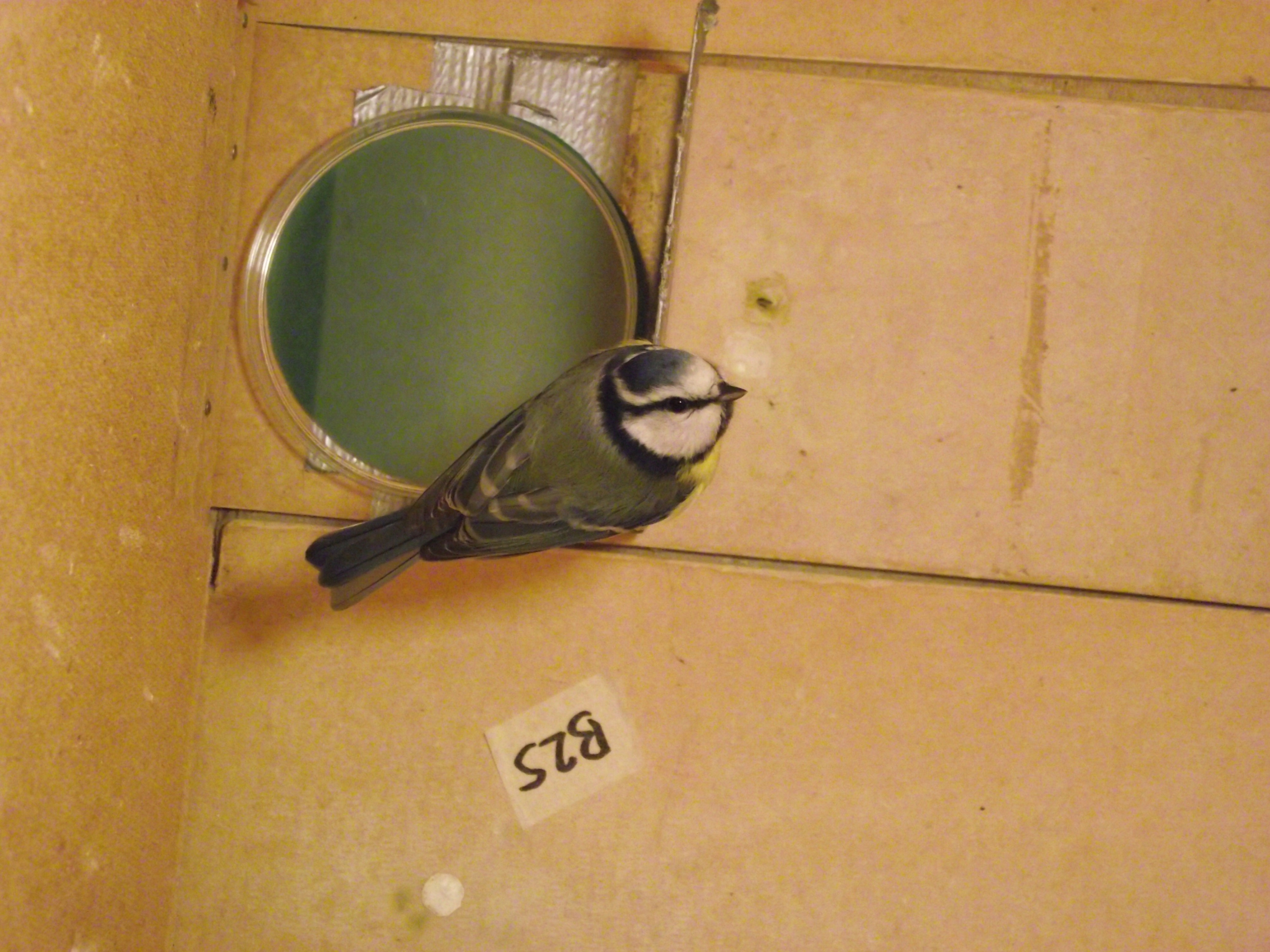
DSCF3058
I may look cute, but I know only hate

1. Blue tits are tiny balls of rage and they will fight you.

2. No seriously, they clearly have not caught up with the evolutionary changes that have occurred since they were dinosaurs. Also they have needle sharp beaks and an uncanny ability to find the softest, most tender, part of your hand to bite.

3. They can learn fast if there are mealworms involved. Not only do they quickly figure out that food appears in the food bowl, but several of them also learnt how the tray the food bowl sits on works. This is bad because it means they can stick their tiny heads through the gap where the tray slides into the cage and steal the mealworm or moth before you even start your experiment! On one occasion I started a trial only to realise the bird had already stolen the mealworm while I was distracted setting up my camera. Other times I have to guard the tray like a hawk and shoo away little bird faces as they poke through the gaps. Interestingly, the fact that they can get so far through the gaps suggests they could probably also get out of the cages if they wanted, but it seems freedom is not as strong a motivator as mealworms.

4. The protocol for catching escaped birds goes something like this:

  • Turn off the lights
  • Wait for bird to land on the floor (they shouldn’t fly when it’s dark)
  • Track bird down using light from a torch or your phone
  • Grab bird
  • Success!

In my experience however one (or several) of the following things actually happen:

  • Bird flies around the room in the dark banging into walls and shrieking like a demon.
  • Bird hangs upside down from light fittings like some kind of bat
  • Bird flies directly at your touch/phone
  • Bird runs around on the floor you are too scared to chase it in case you step on it in the dark
  • Bird lands on you, and then looks at you stupidly as you both wonder how your lives have come to this

If you can’t guess from this list of complaints I’m having a ridiculous amount of fun. I still can’t quite believe they pay me to do this, but long may it continue.

DSCF3006
But WHY are the mealworms gone?

Note: No birds were harmed in the making of this blog post. Many mealworms were though.

New entrance display at the Natural History Museum in London

I don’t know how to feel about this. First they keep changing the layout of Facebook and now this! Don’t people understand that change confuses and frightens me?

On the one hand, I know the entrance displays have changed over the years. Although “Dippy” (I also never quite liked that name but hey, it’s easier to write than “the Diplodocus skeleton”) was there when I first started visiting as a child I also remember that her neck used to go straight up towards the ceiling and her tail trail along the ground. The blue whale skeleton looks pretty cool, but I can’t help thinking it’s not nearly as iconic as a dinosaur. It also makes me sad that I never had the chance to go to Dino Snores. Maybe they’ll remain it Whale Snores?

Edit. My sister suggested they re-name it Whale Song instead. Not as clever as Dino Snores but it works.

PopGroup48

We all have our favorite conferences. Mine is a little strange as technically it’s not even my field. Back when I was doing my masters I had planned on being a geneticist, and PopGroup (The Population Genetics Group) was the first conference I ever attended. Since then, while I certainly haven’t attended every year, I always try and find some excuse to go. My success this year was partly due to my being in the UK around that time anyway (saves on transport costs) and partly because I made a point of helping out the geneticists in my labgroup with some of their more repetitive work. This has the added benefit of making sure I don’t totally forget all the skills I learnt in my masters. Its always good to remind yourself how to build a haplotype network, even if you’re a chemical ecologist.

This year’s journey was thankfully free of bomb scares and, despite my initial doubts, the students union in Sheffield was a lovely venue (I really liked the food as well). As usual the quality of the talks was very high, although there seemed to be fewer method talks this year, or perhaps I just missed them. One benefit I find of attending PopGroup is I learn about the latest shiny new technique for sequencing, but this year the emphasis seems to be less on the techniques themselves and more on how to interpret the data they produce.

There were a lot of talks I particularly enjoyed, but since I’ve talked about them in the “Not those kind of doctors” podcast (see the end of this post for the video) I’m not going to repeat myself here.  Sadly I didn’t see either of the winning student talks (Simon Martin and Martina Rauscher) this year, although I did hear good things from people who did. Rodrigo Pracana won the poster prize for her poster on “Genetic variability of captive populations of a highly eusocial stingless bee.” Alas it seems the Scottish universities have lost their edge this year.

I will mention however the final plenary talk by Simon Myers. The final slot of a conference is always a mixed blessing, and having done a bit too much Cèilidh-ing the night before, I was admittedly expecting to doze through it. However, Simon’s talk on ancient admixture in human populations really woke me up. The study focused on looking at gene flow into and within the UK and Spain. As someone who was really into early human history as a kid, learning about the genetic signals of things like the Viking and Anglo-Saxon colonisations was fascinating.

I also got to see a lot of old friends and, hopefully, make a few new ones as well. The next PopGroup is going to be in Edinburgh so that is extra motivation for me to start preparing my reasons to attend for next year!

Not those kind of doctors Ep. 7

We’re back with an episode on conferences where we discuss the unreliability of abstracts and the wonders of conference twitter.

To see Claire’s academia.edu account click here: https://nottingham.academia.edu/ClaireBurdfield

and if you fancy watching Emily in action at a conference you can see a video of one of her talks here: https://www.youtube.com/watch?v=FOlxLhF13q4

Not those kind of doctors Ep. 6

Welcome to episode 6 where we are finally relevant! We talk about topics from our fields that have been in the news, and once again fail to keep to time. Apologies for the weird sound and lighting effects, I need better hardware.

For more on seal on penguin sex (as well as the aforementioned videos) see the bbc story: http://www.bbc.com/earth/story/20141117-why-seals-have-sex-with-penguins

To rate a trailer go here:
http://www.bbfc.co.uk/education-resources/student-guide/rate-a-trailer

If you want a great example of children’s media done right check out ParaNorman:
http://en.wikipedia.org/wiki/ParaNorman
(We had to cut our section on this due to time but it is an awesome film.)