Natural History museums are some of my favourite places to visit and, since I was recently in Braunschweig, I took the opportunity to visit the Naturhistorische Museum Braunschweig. Someone told me this is the oldest museum in Europe, while the museum website has the slightly more modest claim of being the oldest museum in Germany. In any case it was founded in 1754 by Carl I. of Brunswick and Luneburg, and is currently housed right next to the university.
Everyone needs an elephant embryo.
The museum itself is a decent size, spanning four floors (there is a lift of stairs are not your friend). All the information in the museum is in German, but I was generally able to work out what each section was. On the ground floor there is a small section dedicated to its founder, with some cool examples from his original collection. At first it seemed to be a typical, slightly old fashioned, museum, with stuffed animals arranged in little murals. Each mural contained one main species, plus one of two smaller species slightly hidden amongst the fake vegetation. There was also a nice insect section, with information on the huge number of insect species as well as some cool examples of wasp and ant nests.
This bird scares me…
A model in the insect section
Butterflies!
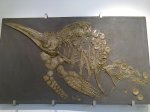
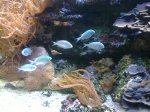
The museum really comes into its own on the upper floors. There was an impressive dinosaur room, with touchscreens showing information on the excavation programs, as well as ton and ton of fossils. Possibly my favour part was the microscopes they had set up so you could view microfossils and insects preserved in amber. Given that no natural history museum is complete these days without live animals, they also have an aquarium and vivarium in the basement with a good range of animals.
The giant crab now required by law in all Natural History museums
Winter is coming…
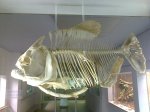
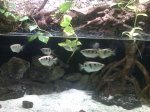
Fish
So in summary:
Price? 4 euros for an adult. There is also a student discount and education groups go free.
Interactive? A bit, there were some touchscreens around the place showing videos and other information. The fossil section also had the aforementioned microscopes, plus draws to pull out and some phones playing animals calls.
Educational? Yes. There was a good amount of information on topics like evolution, ecology and conservation. In particular the section on insects has some nice examples of food webs and there was even a display dedicated to human evolution.
Adults or kids? This museum is probably aimed more towards adults, but there certainly seemed to be enough to keep kids happy too.
Shop? The shop was small but carried all the required novelty pencils, plastic dinosaurs and soft toys.
Overall? It was good value for money and the staff seemed friendly despite language barrier. I would definitely recommend a visit if you are in the area.
So I recently moved to Finland to start my post-doc. It’s all been a bit crazy what with trying to write up, publish a bunch of papers and fit all my worldly belongings into two suitcases. Well, actually, it’s still a bit crazy but nothing motivates you to write blog posts like procrastination so here goes!
I’ve joined Johanna Mappes’ lab and I’m going to be working on variation in chemical protection in the wood tiger moth. Here is a photo of a wood tiger moth. Aren’t they cute? They definitely help make up for having to say goodbye to all my old lab pets (sob).
I did not take this photo, I stole it off a co-workers fb page.
So I will have to think of a new name for this blog (and my twitter feed). Not that it’s urgent, this is not exactly an active website 🙂
Also Finland is awesome, not sure about their coffee though…
My trip to PopGroup got off to a shaky start this year when a “potentially suspicious” package shut down Edinburgh Airport hours before we were due to fly to Bristol. Thus, while everyone else was drinking wine in the roman baths, we were stuck in a hotel lobby waiting for updates via twitter. Eventually we were allowed back in the airport and made it to Bath around 1am.
Despite this, the conference was very enjoyable. The venue (the Assembly rooms) was beautiful and conveniently placed a short walk from the centre of Bath and the long lunch breaks gave us ample time to get out into the city. We even had a bit of sunshine!
Bath Abbey
The quality of the talks was very high (I feel like everyone always says this about conferences, but it is true!) My favourite was the plenary given by Dr Lilach Hadany on stress-induced variation. She talked about the ways in which stress-induced recombination, dispersal and mutation can all spread through populations. The idea being that individuals of low fitness (that are therefore stressed) have more to gain from changing their phenotype than successful individuals. Thus, “the living dead can take any risk”. I also liked Krzysztof Kozak’s talk on the non-hybrid origin of the butterfly Heliconius hermathena. The talk pretty much does what it says on the tin, despite its hybrid phenotype, genotypic evidence suggests that the species is not the result of hybridisation at all. Instead its characteristic zebra pattern may be ancestral, or have evolved multiple times.
As for prizes, the Scottish universities clearly came out on top. The prizes for best student and best post-doc talk went to Sam Lewis and Susan Johnston respectively. The prize for best post-doc poster also went to Edinburgh. In fact the student poster prize was the only one to go to a different university, as I won it! A clear indication of the value of summing up you findings clearly and succinctly, even if they are not what you were hoping for.
Finally, the conference dinner was delicious and the live band very impressive. I only wish I could say the same for the DJ! At least he did his bit for the local pubs of Bath by forcing us all out of the venue in search of better music.
It’s been a busy couple of months; I’ve gone from never having spoken at a conference to having talked at three. Admittedly I was also the organiser of one, but still I that still leaves two ‘real’ conferences.
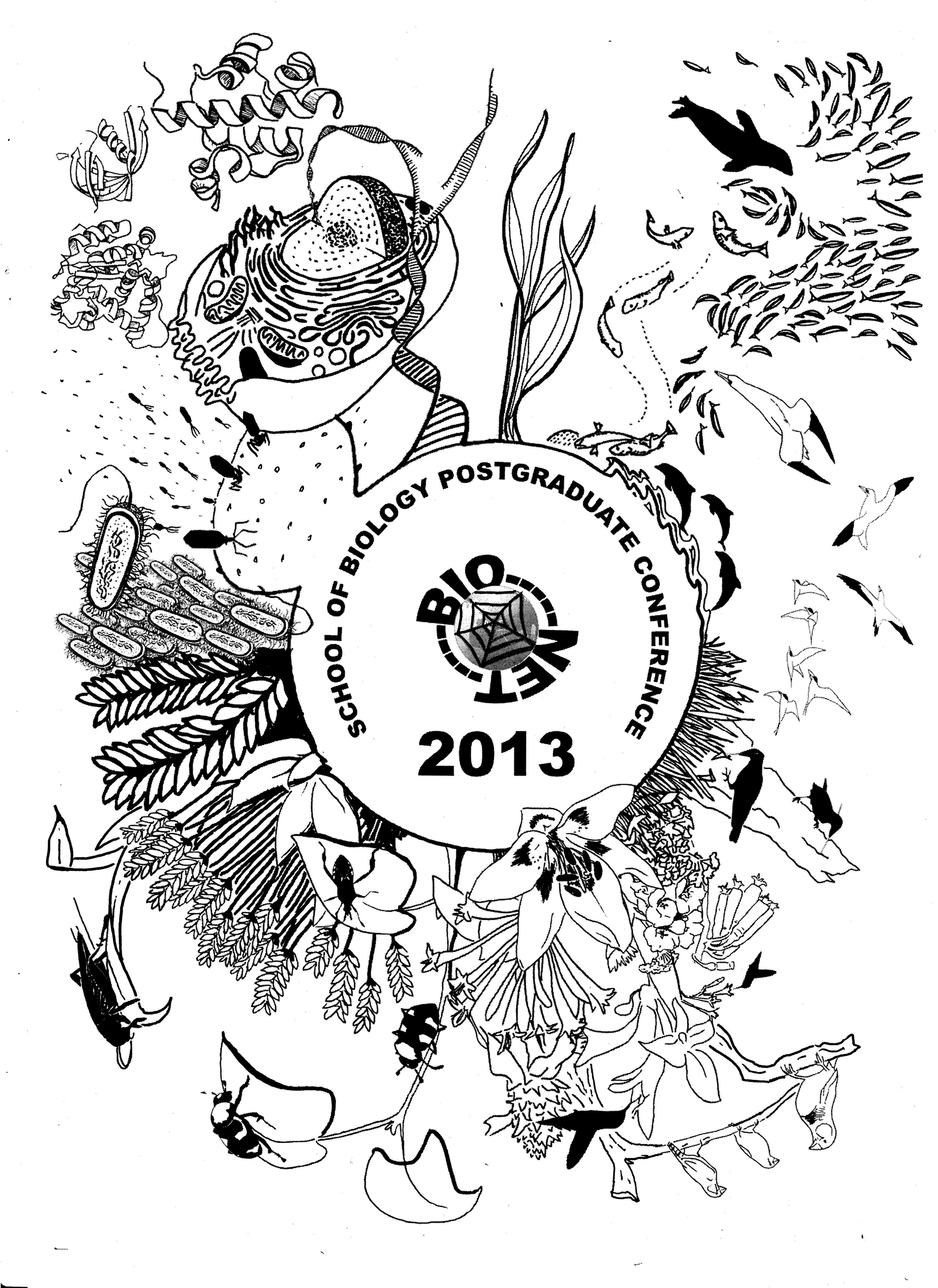
Our beautiful poster (not designed by me!)
Conference number one was the St Andrews School of Biology Postgraduate conference. As the president of the Postgraduate Bio-Network I was in charge of organising this one. I’ll be the first to admit I haven’t exactly been the most active president in the BioNet’s history (most of the actual running of the network was done by my co-president, now sadly banished to the wilds of Glasgow) so I was determined to prove my worth and actually do a good job on this one. Despite some panic early on in the organisation, when I was having trouble securing a venue, the whole thing went off remarkably smoothly. Indeed one of the major complaints was a distressing lack of biscuits during the coffee breaks, a problem that was quickly fixed by a trip to Tesco. Attendance was somewhat sporadic, as is always the case when you demand a bunch of stressed-out PhD students leave their labs for two days to learn about each-other’s work, but the wine reception and ceilidh were both well-attended. I’m proud to report that my talk was voted 3rd best (alas there were only prizes for 1st and 2nd place but at least that way I avoided any accusations of fixing!). 1st prize went to an excellent talk on the effect of temperature on jellyfish, and second to a talk of the effects of oxytocin in seals.
A good time was had by all…
The poster prizes were taken by a pair of very originally designed posters on Guppy behaviour, one of which resembled a comic strip. Perhaps unsurprisingly, I found actually talking one of the least stressful parts of the conference (with the exception of the ceilidh).
The second conference took place the day after the first (and hence the morning after some considerable drinking and dancing on my part). The Scottish Conference on Animal Behaviour (somewhat unfortunately abbreviated to SCAB) is a friendly little conference held this year in Glasgow. After an early start to drive cross-country in the snow, we were relieved to find plentiful coffee and no shortage of biscuits upon arrival. The breaks and poster session where held in the Zoology Museum in Glasgow University, an awesome venue with a particularly original entomology section. The quality of all the talks and posters was very high, the only slight distraction being the lack of heat in the lecture theatre. The range of the talks was also excellent, everything from insect behaviour to fish development. My favourite talk was on sexual swellings in primates and best talk was awarded to a presentation on age-dependent behaviour in the wandering albatross. I was in the final session and so nervous I did my 15 minute talk in less than 10. Despite this I apparently made sense and did at least get our session back on time as the talk before mine had overrun. Sadly any attempts at socialising were cut short as there was only time for one glass of wine before we were back in the car to get home before dark.
The final conference of the spring was the ASAB Easter meeting. This year it was held in sunny Lincoln and, surprisingly, it was actually quite sunny. The conference started with a workshop on Sensory Ecology. While a lot of the talks were not really relevant to my work (good luck getting a seed bug to use a touch screen) it was nevertheless engaging. In particular the talk on how animals perceive and use signals got me thinking more about how the aposematic nature of my bugs might influence their communication. While going to a conference with people from your own department can sometimes end with you talking only to each other, this time it worked in my favour. My companions knew some of the other attendees from masters courses and previous conferences and so were able to introduce me to several lovely new people. This is useful for me as if left to my own devices I tend to lurk in corners consumed by social anxiety, hardly an effective networking strategy. I also had the chance to chat to a student who will be joining our lab come September and hopefully helped impress upon her the extent to which alcohol plays a role in the design of new experiments.
I could try and describe all the good student talks (of which there were many) but that may push this post over the 1000 word mark and ensure no-one ever reads it. Suffice to say the overall trends of the conference, to my mind at least, were learning (in the form of discrimination tasks) and personality (thankfully based on repeatable behaviours and not pet owner questionnaires). The winning talk was on the effects of induced sickness on bee learning, a study which while interesting did make me feel for the poor queasy little bees. Personally, the fact that has most stuck with me from the whole conference is that tortoises prefer mango jelly to apple jelly. Sadly their thoughts on strawberry jelly remain unknown to science.
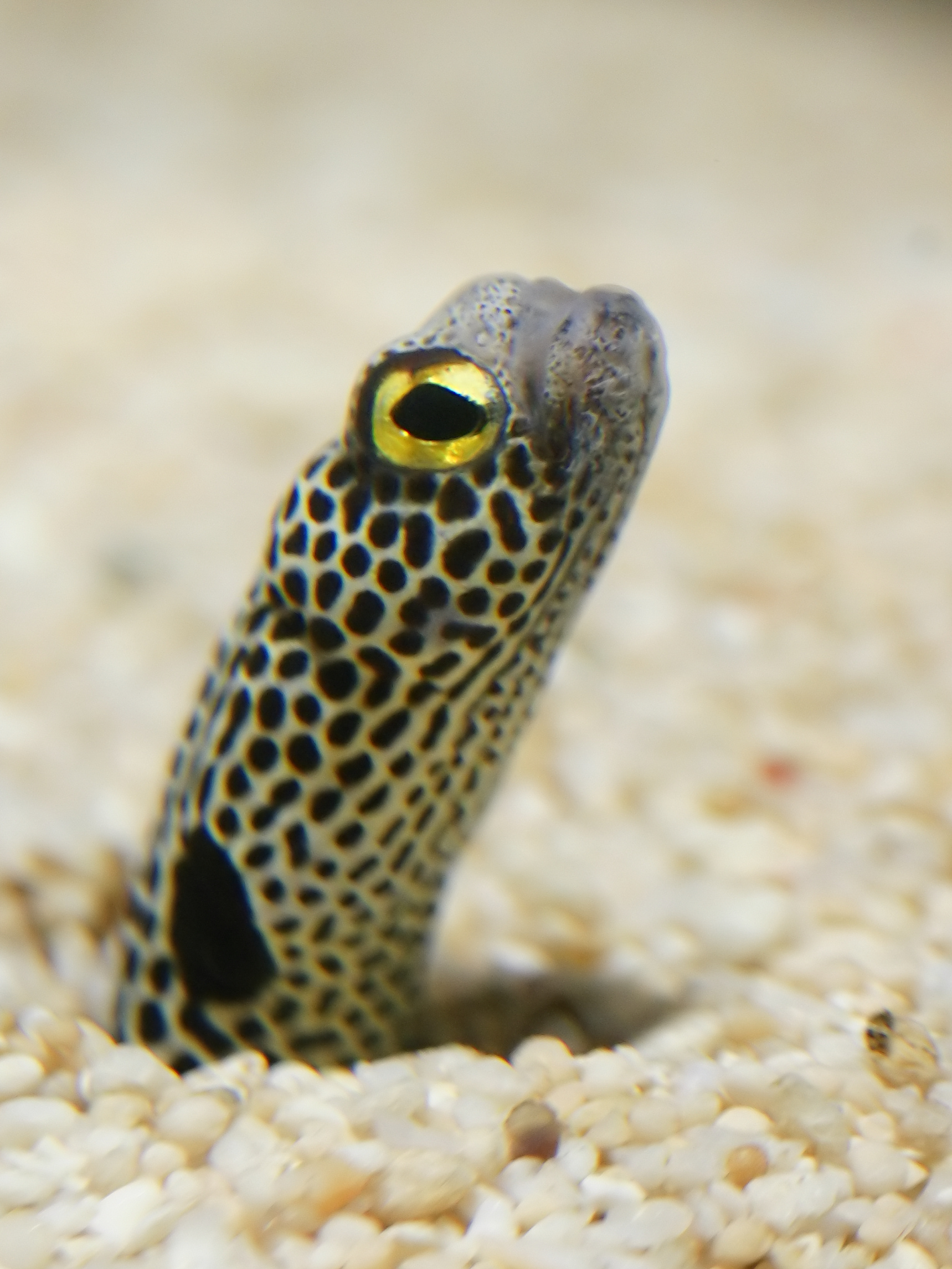
The highlight of the whole thing was undoubtedly the dinner. It was held the The Deep, an aquarium in Hull. This did necessitate an hour long coach trip that felt remarkably like a school trip but it was well worth it. Upon arrival we were provided with small cones of fish and chips and let loose in the now-empty aquarium. Asking a biologist to pick their favourite animals is near impossible, but a special mention has to go to the jellyfish and the garden eels (see below).
So that concludes my conference round-up. I will now be forced to actually concentrate on my own work, at least until ESEB and ENTO 2013 later in the summer.
A garden eel courtesy of wiki commonsI took this one myself
When I was a kid I wanted to be the next David Attenborough. In fact as an undergraduate doing Zoology that was the dream of most of my course mates as well. Still, as I got older I realised that it was time to let go of such silly ideas and focus on being one of the people who pedantically points out the flaws in wildlife documentaries instead. So it came as something of a surprise last Tuesday to find myself on the set of an actual wildlife documentary carefully herding insects into position for the camera.
The story starts a couple of weeks ago when my supervisor was contacted by a researcher from a film production company. They are currently making a documentary on Arthropods filmed entirely in 3D. They knew my supervisor worked on sexual behaviour in insects and wanted him to bring some down to their studio in London to be filmed. Unfortunately for him* he was too busy to go, so instead my lab mate and I found ourselves drinking complimentary coffee while watching a professional crew laboriously film a succession of weird and wonderful animals on an incredible 3D camera. I’ll admit that, up until now, the 3D craze has left me rather cold, but seeing insects and spiders up close in HD 3D was a revelation. Even familiar species like our wasps and seed bugs appeared in a whole new light.
Filming in 3D is no small task however, the field of focus is limited, the lights are hellishly hot and the subject matter is profoundly uncooperative. After assuring the crew that my bugs would mate on camera “no problem” and that they “never flew” they then proceeded to fly into the backing sheet and mate on that while steadfastly refusing to mate on the branch we had provided for them. This was overcome by allowing them to mate in petri dishes before transferring them to the branch with the use of several twigs. The wasps were eventually successfully filmed with the help of a lot of furniture polish (it temporarily knocks them out) and a very steady hand with a paintbrush. Despite all this the shots looked amazing. We won’t know for certain what will make the final cut until the show comes out, but fingers crossed when it does my name will be there in the credits, in tiny tiny font, but there nonetheless.
A paper of mine recently got someattentiononline. This was exciting for various reasons (I even had a phone interview! Like a real scientist!). However, by far my favourite part of finding out what news sites have picked up the story each day is reading the comments.
Oh internet, never change.
In fact the majority of the comments have been disappointingly sensible. Despite this there are still some gems and I have begun keeping a list of my favourites. So, in no particular order, here are some of the best things anonymous individuals have said about my work on the internet:
“While I understand the objective of the study, it seems to me that this is another case of Words being used to describe Things.” – Truer words were never spoken, Dresan from io9.
This exchange between dudewitch and Brawno also of io9 gets right to the heart of the issue:
“‘They found, for example, that female sexual cannibals were described with overwhelmingly negative language.’ Comedy.”
“Exactly. I’m shocked (shocked!) that female sexual cannibals are described with negative language. This seems like a textbook case of female sexual cannibal bias if I ever saw one.”
Meanwhile jscroft of phys.org clearly understands how vital our work is:
“Boy I hope these guys received a bunch of taxpayer funding to answer this VERY pressing and important question. Good Lord.”
There has also been some suggestion that we are simply after an Ignoble prize. I wish. It’s not nearly silly or funny enough for that. Perhaps a follow up study on the language used in comments about studies on language use might do the trick…..
As of yet no-one yet has accused me of being an evil feminist (maybe having two male co-authors helped) but I will keep you updated.
I’m just starting the 3rd year of my PhD at St. Andrews. I am interested in the evolution of sexual traits and how these affect species ecology.
My working title is: Investigating the causes and consequences of reproductive interference in the Lygaeidae.
Reproductive Interference
Reproductive interference (or RI) is when individuals of one species engage in reproductive activities with individuals of another species, and these interactions reduce the fitness of one or both species. These reproductive interactions can be anything from interfering with sexual signalling, for example the calls of one species of frog masking those of another, to actual attempts to mate with other species.
Study system
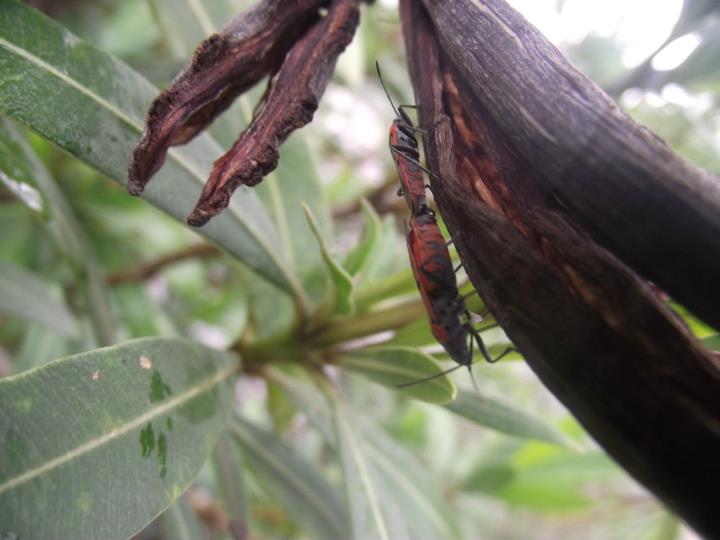
The Lygaeidae (commonly called seed bugs) are a family of true bugs found worldwide. My work focuses on five species collected from Europe and the USA. Thus I can study interactions between species that naturally co-exist in the wild as well as those who would normally never encounter each other.
Two Lygaeidae (Lygaeus simulans) copulating
Questions
What causes animals to mate with the “wrong” species?
In order to answer this question I am looking at the effect of context and previous experience on mate preferences. I am also investigating a possible role of circular hydrocarbons as inter and intra specific signals that could be used in mate recognition and mate choice.
What are the fitness consequences of reproductive interference?
So far I have looked at the effect of harassment by heterospecific males on female seed bugs. I am now looking at how males change their mating strategies in the presence of heterospecific males.
I’m Bugphd. As my name suggests I’m a PhD student at the University of St Andrews studying (surprise surprise) bugs. To be more specific I am interested in the evolution of sexual traits and how these affect species ecology, in particular the causes and consequences of reproductive interference in the Lygaeidae.
I occasionally blog about my life as a postgraduate student over at Inside St Andrews so this blog is going to be for all the stuff I write for them and then decide is either too silly, too self-obsessed or too academic to post there. Topics that are likely to come up are: my research, procrastination, and anything involving spiders.











 Insect Chemical and Evolutionary Ecology